If you are considering the 1more hq20 wireless headphones, the main reason to choose them is safe, low-stress listening for kids and students. They are not the flashy option for heavy bass or advanced noise cancellation; they make more sense when volume control, comfort, study use, and long battery life matter more than entertainment features.
How Does 1MORE HQ20 Protect Hearing?
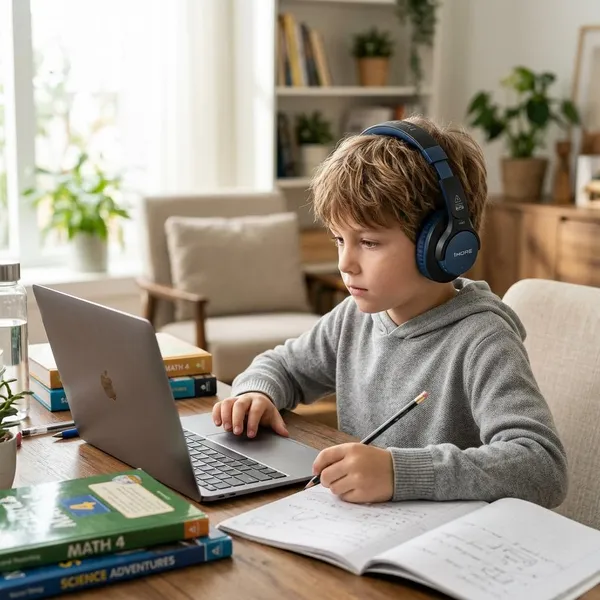
The HQ20 is built around safer listening rather than just louder sound. Its hearing-protection setup is most useful for children who use headphones often, students who switch between lessons and videos, or families who do not want to manage volume manually all day.
- For quiet homework: start with the lowest comfortable limit.
- For older students: use a higher limit only if speech becomes too hard to hear.
- For travel or noisy rooms: rely on the ear-cup seal first before raising volume.
- For younger kids: treat the safety lights as a quick visual check, not a feature to ignore.
Three adjustable volume limits
The HQ20 offers three selectable limits: 75 dB, 85 dB, and 95 dB. That range is more practical than a single fixed cap because a child listening to an audiobook in a quiet bedroom does not need the same setting as an older student using a tablet in a busier room.
For everyday use, the lower settings are the safer place to start. The 95 dB option is better treated as a short-term flexibility setting, not the default for long listening sessions.
Automatic volume control
Automatic volume control helps when the loudness changes suddenly between apps, videos, ads, games, or lesson recordings. That is important because a child may not raise the volume on purpose, but the content itself can still jump in level.
This feature should not replace good listening habits. It works best as a backup layer after you have already chosen a sensible volume limit.
Color-coded safety lights
The color-coded lights make volume safety easier to understand at a glance. A parent does not need to open Bluetooth settings every time, and a younger listener gets a simple visual cue instead of a technical explanation about decibels.
Noise-isolating ear cups
The HQ20 uses passive isolation from its over-ear cups rather than active noise cancellation. That can still be enough for household noise, light travel, or a study corner near a TV, and it often helps users avoid turning the volume up just to hear speech clearly.
If the room is very loud, though, passive isolation has limits. In that case, moving to a quieter spot is a better first step than simply raising the volume limit.
How Comfortable Is 1MORE HQ20?
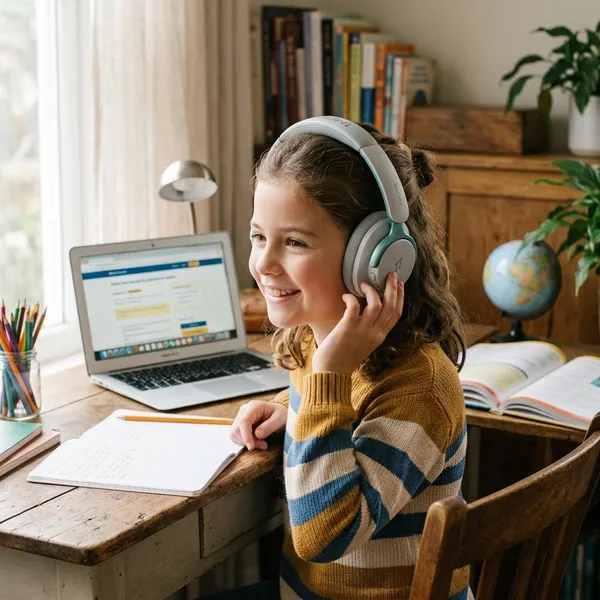
Comfort matters because hearing-safe headphones are only useful if the child or student actually keeps them on properly. The HQ20 does well here by keeping the design light, padded, adjustable, and easier to store between uses.
181g lightweight build
At about 181g, the HQ20 is light enough for regular use without feeling bulky. That lower weight helps during longer study sessions, but it also matters for children who move around, look down at books, or switch between a desk and couch.
Memory foam ear cushions
The soft ear cushions help spread pressure around the ears instead of creating sharp contact points. That makes a difference after the first 20 or 30 minutes, when stiff pads often start to feel annoying.
They also support the passive seal. A better seal means the listener can usually keep the volume lower while still hearing lessons, calls, or audiobooks clearly.
Adjustable padded headband
The adjustable padded headband gives the HQ20 more flexibility across different head sizes. That makes it more useful in a household where one pair may be shared by siblings or occasionally borrowed by an adult for a call or quiet listening.
- Too loose: the ear cups may not seal well.
- Too tight: pressure builds during longer sessions.
- Correct fit: the cups sit fully over the ears without needing constant adjustment.
Foldable rotating ear cups
Foldable rotating ear cups are not exciting on paper, but they make the HQ20 easier to live with. Rotation helps the pads sit more naturally, while the folding design makes it simpler to put the headphones in a school bag, drawer, or travel case.
How Does 1MORE HQ20 Perform for Study?
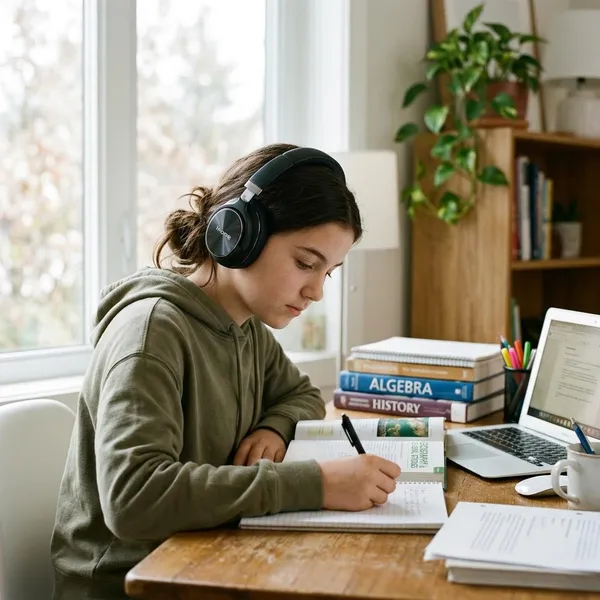
For study use, the HQ20 focuses on the right basics: clear speech, enough isolation to reduce distractions, dual-device connection, and a built-in microphone. That is more useful for most students than extra audio effects they may rarely need for schoolwork.
40mm drivers keep speech clear
The 40mm drivers should be more than enough for lessons, audiobooks, language apps, and video classes. The important point is not whether the HQ20 sounds dramatic, but whether voices are easy to follow without pushing the volume too high.
For music-first buyers, this may not be the most exciting choice. For a student who mostly listens to teachers, videos, and spoken instructions, clear mids and comfortable volume are the better priority.
Passive isolation helps focus
Passive isolation helps create a quieter personal space without adding the cost or battery demand of active noise cancellation. It is useful for light household noise, such as conversation in another room, a fan, or traffic outside a window.
Dual-device connection makes switching easy
Dual-device connection is one of the HQ20's most practical study features. A student can stay connected to a tablet and laptop, or a phone and Chromebook, without repeatedly digging through Bluetooth menus.
This is especially helpful for younger users. If switching devices becomes frustrating, they may give up, use the device speaker, or ask for help every time. Multi-point pairing removes a small but common daily irritation.
Built-in mic supports classes and calls
The built-in mic makes the HQ20 suitable for online classes, language practice, quick calls, and family chats. It is not meant to replace a dedicated work headset for serious conferencing, but it keeps a school setup simple: one headphone for listening and speaking.
1MORE HQ20 Battery and Charging
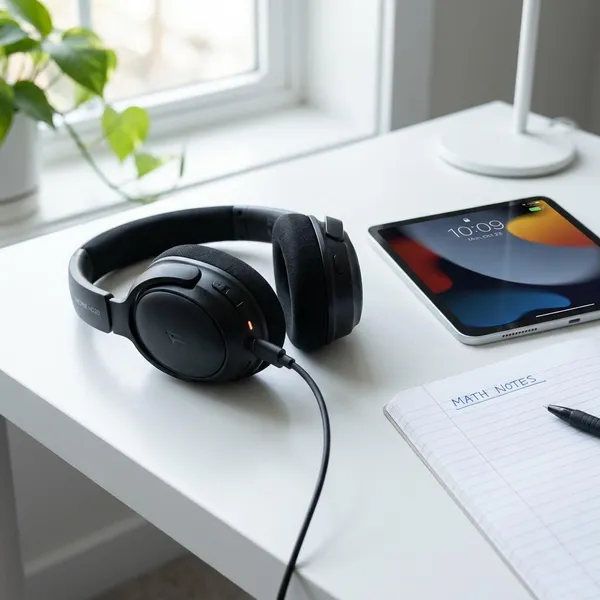
Battery life is one of the easiest reasons to like the HQ20. With a rated battery life of up to 65 hours, it should handle several school days or many short listening sessions before needing a full recharge, depending on volume and use.
The real benefit is fewer interruptions. For a family device that may be used for homework one day, a video call the next, and travel at the weekend, long battery life reduces the chance that the headphones are dead exactly when they are needed.
Up to 65 hours per charge
Up to 65 hours per charge is strong for a student-focused wireless headphone. Real-world time will vary, but the HQ20 should still be forgiving for users who forget to charge devices every night.
If the headphones are used lightly, a single charge may last a long stretch of routine home use. For daily online classes, it is still smart to build a simple weekly charging habit instead of waiting for the battery warning.
5-minute charge adds 2.5 hours
A 5-minute charge for up to 2.5 hours of playback is useful when the battery problem appears right before class, a car ride, or a homework session. It is a rescue feature, not a reason to avoid normal charging, but it can save a busy morning.
USB-C handles everyday charging
USB-C makes the HQ20 easier to keep charged because many homes already use the same cable type for tablets, Chromebooks, phones, or power banks. That small convenience matters more with kids' headphones than it might seem, because the easier the charging routine is, the more likely the headphones are ready when needed.
Conclusion
The HQ20 is the better fit if your priority is safe listening, study comfort, and simple daily reliability. Choose it for kids, students, shared family use, and long battery life; look more toward the HQ31 if active noise cancellation, LDAC, spatial audio, or a more entertainment-focused feature set matters more than volume safety.