If you are choosing between an action camera vs smartphone, the short answer is simple: use your phone for everyday photos, city travel, low light, and fast sharing; use an action camera when the camera may get wet, shaken, mounted, or dropped. Image quality matters, but the bigger difference is where you film and how much risk you are putting on your main phone.
Key Differences Between Action Cameras and Smartphones
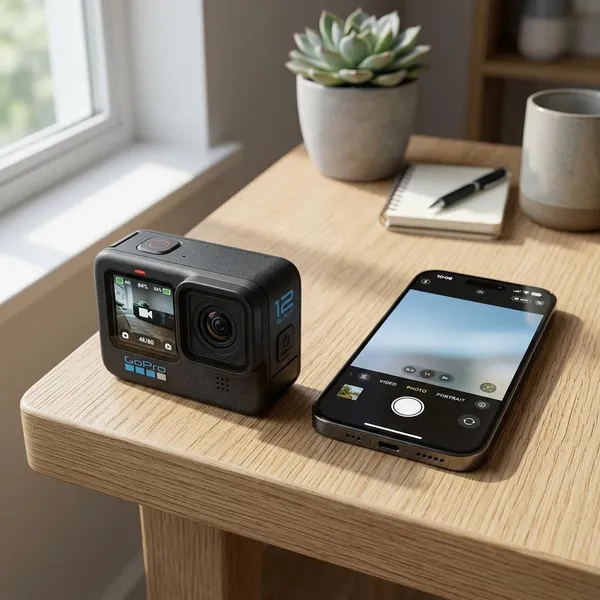
The easiest way to compare them is by job, not by megapixels. A smartphone is a flexible daily camera with strong processing and instant sharing. An action camera is a small, rugged filming tool made for movement, mounts, water, and awkward angles.
| What matters most | Better choice | Why it matters in real use |
|---|---|---|
| Quick photos and social clips | Smartphone | You can shoot, edit, message, and post from the same device. |
| Mounted or hands-free filming | Action camera | It is lighter, easier to secure, and less stressful to attach to gear. |
| Water, dust, and impact risk | Action camera | It is built for rougher use, while your phone is also your map, wallet, and communication device. |
| Indoor or evening scenes | Smartphone | Modern phones usually process low-light scenes better. |
Smartphones offer better camera flexibility
A smartphone is stronger when the scene keeps changing. You can switch from a wide street view to a portrait, a food photo, a short video, or a zoomed detail without changing gear. That makes it better for casual travel, family moments, and quick content where you do not want to think about settings.
Action cameras offer greater durability
An action camera is the safer choice when filming could involve drops, sand, rain, mud, saltwater spray, or constant handling. Even if your phone has water resistance, it is not something most people want to risk repeatedly at the beach, on a trail, or on a boat.
Action cameras provide easier mounting
Mounting is where action cameras feel purpose-built. They work well on helmets, chest straps, handlebars, backpacks, surfboards, dashboards, and small tripods because they are light and shaped for accessories.
- Choose an action camera if the camera needs to stay attached while you move.
- Use a phone mount only for calmer setups, such as a desk vlog, tripod shot, or parked-car clip.
- Avoid risky phone mounts if losing the phone would also mean losing maps, payments, or emergency contact.
Action cameras handle movement better
Action cameras usually win for running, riding, skiing, paddling, and other shaky situations. Their wide view and stabilization make it easier to capture usable footage even when your framing is not perfect.
A smartphone can look excellent for walking clips or handheld travel video, but heavy vibration and fast changes in direction are harder on a larger device. If the camera is attached to your body or gear, an action camera is usually more reliable.
Smartphones perform better in low light
Phones are usually better indoors, at dinner, at home in the evening, or on city streets after dark. Night modes, HDR, and image processing help them produce cleaner results with less noise and more usable color.
Action cameras prefer daylight. They can record in dim conditions, but fast movement in low light often leads to softer, grainier footage.
Smartphones make editing and sharing easier
If you want to record a clip and post it within minutes, the phone is hard to beat. There is no file transfer, no separate battery to check, and no extra app workflow unless you want one. For daily social clips, that convenience often matters more than ruggedness.
Which Camera Is Better for Your Use?
The right choice depends on your most common filming situation. A parent recording a birthday, a traveler walking through a city, and a cyclist filming a downhill ride do not need the same camera. Start with your real use, then decide whether convenience or protection matters more.
Smartphones are better for city travel
For city travel, a smartphone is usually the better camera. You already need it for maps, bookings, payments, messages, and translation, so it naturally becomes the camera you reach for fastest.
Action cameras are better for outdoor trips
Outdoor trips are different because weather and terrain can change quickly. A small rugged camera is easier to clip to a backpack strap, hold with wet hands, or keep recording while your phone stays protected.
Action cameras are better for water sports
For surfing, kayaking, snorkeling, paddleboarding, or poolside filming, an action camera is the smarter choice. Phone water resistance is useful for accidents, but it should not be treated as permission to use the phone like a dedicated water camera.
- Low-risk splash: a phone may be fine if it stays mostly dry and protected.
- Repeated water exposure: use an action camera instead.
- Saltwater or waves: avoid making your main phone the test device.
Smartphones are better for daily vlogging
Daily vlogging is usually easier on a phone because framing, audio checks, editing, captions, and uploading all happen in one place. If your videos are mostly talking to the camera, showing your routine, or filming quick updates, a smartphone is more convenient.
An action camera can still be useful for a second angle, a bike ride, a hike, or a hands-free walking shot. It is just not as smooth as a phone for everyday recording and posting.
Action cameras are better for biking and skiing
Biking and skiing are classic action camera situations: speed, vibration, cold air, gloves, uneven ground, and possible falls. A helmet or chest-mounted action camera captures the viewpoint safely while keeping your hands free.
Smartphones are better for family photos
Family photos usually look better and feel easier on a phone. Portrait modes, face detection, better low-light processing, and instant sharing all help with birthdays, dinners, school events, holidays, and everyday home moments.
An action camera can be fun for wide, playful shots, especially outdoors, but it is not the first tool most people should pick for flattering portraits or indoor people photos.
How to Choose Between an Action Camera and a Phone
Make the decision in this order: where you film most, whether you need mounting, how much water or impact risk there is, how often you shoot in low light, how fast you need to share, and what the full setup will cost. That order keeps the choice practical instead of turning it into a spec comparison.
Check where you film most
Write down your three most common filming situations. If the list is home, restaurants, city walks, family events, and quick social clips, your phone is probably enough. If the list includes trails, beaches, bikes, boats, snow, or long outdoor days, an action camera becomes easier to justify.
Decide if you need mounting
Need hands-free footage more than occasionally? Choose an action camera. Mounting is not just an accessory issue; it changes whether you can film safely and consistently.
For a desk vlog or tripod recipe shot, a phone mount is fine. For chest, helmet, handlebar, board, or backpack footage, a dedicated action camera is usually the cleaner setup.
Consider water and impact risks
This is the biggest risk check: ask what happens if the device gets dropped, splashed, covered in sand, or knocked loose. If the answer is "I would be in real trouble without my phone," do not put the phone in that position unless the risk is very low.
Compare low-light needs
If you mostly shoot indoors, at night, or in mixed lighting, lean toward the smartphone. It will usually give you cleaner, more shareable results with less effort.
Think about editing and sharing
Choose the phone if fast posting is part of the reason you film. Short-form creators, parents sending clips to family, and travelers posting during the day all benefit from keeping capture and editing on one device.
- Post immediately: smartphone.
- Edit later after an activity: action camera can work well.
- Need both talking clips and action footage: use the phone as the main camera and the action camera for risky or mounted shots.
Set your total gear budget
Do not compare only the price of the camera body. An action camera may also need mounts, memory cards, spare batteries, a case, or a float grip for water. A phone may cost nothing extra if you already own a good one, but using it in risky places can turn into an expensive repair.
Conclusion
Your phone is the better all-round camera for daily life, low light, family photos, city travel, and quick sharing. An action camera is worth choosing when filming becomes physical: mounted angles, water, dust, speed, impact risk, or long outdoor sessions. If you only film casually, keep using your phone; if you regularly protect your phone before pressing record, that is the sign an action camera has a real job to do.