The most useful answer is: China's first console depends on what you mean by "first." For the earliest known domestic hardware, look at CY-A and YQ-1; for the console many families actually remember, look at Little Tyrant; for official Nintendo hardware made for mainland China, the answer is the iQue Player.
What was China's first console?
If you need one quick answer for a casual conversation, Little Tyrant is often the name people recognize. If you need the more historically careful answer, CY-A and YQ-1 belong earlier in the timeline. The confusion comes from treating "first made," "first widely owned," and "first officially backed by Nintendo" as the same thing.
| Question you are really asking | Best answer | Why it fits |
|---|---|---|
| Earliest Chinese-made TV game hardware | CY-A or YQ-1 | Early domestic Pong-style systems from around 1980–1981 |
| First console many Chinese households remember | Little Tyrant | Mass-market Famicom-style home gaming in the 1990s |
| First official Nintendo home hardware for mainland China | iQue Player | Nintendo-backed, localized hardware released in 2003 |
China's earliest domestic game consoles
The earliest part of China's console history is easy to overlook because it does not look like the console market people remember from the 1990s. These machines were often built around fixed ball-and-paddle games, simple controls, and direct TV connection rather than cartridges, large libraries, or recognizable game characters.
CY-A and early Pong-style TV games
The CY-A is commonly described as an early Chinese TV game console from around 1980, associated with Shanghai's Chunlei Electronic Instrument Factory. It fits the Pong-era pattern: built-in sports-style games, paddle controls, and modest visuals designed for household televisions.
YQ-1 and early mainland console development
The YQ-1 is often dated to around 1981 and described as one of mainland China's earliest game consoles. Like other systems of its period, it appears to have been a simple TV game device rather than a full software platform in the later sense.
- Good answer for strict history: mention YQ-1 alongside CY-A.
- Risky shortcut: calling it the undisputed first without noting uncertainty.
- Best framing: one of the earliest known mainland console efforts.
Other Chinese Pong-style systems from the early 1980s
CY-A and YQ-1 were part of a wider early-TV-game environment. Collector records and scattered references point to other Pong-style machines from mainland China, Hong Kong, and Taiwan during the early 1980s, although the evidence is uneven.
Why Little Tyrant became China's best-known early console
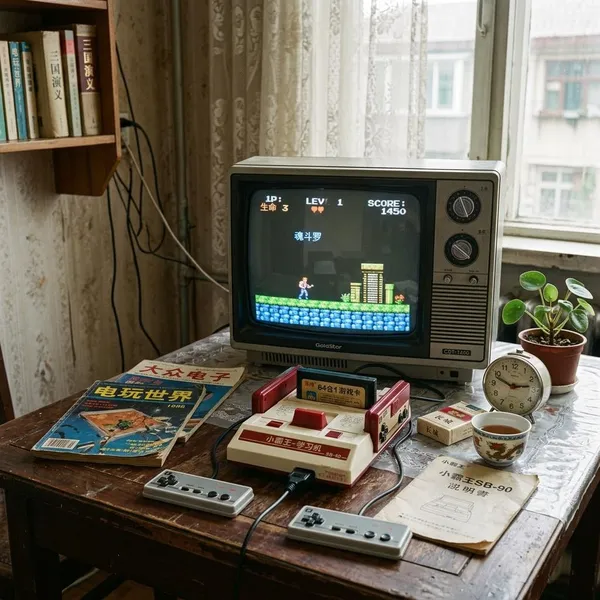
Little Tyrant became the best-known early console because it solved a different problem from CY-A or YQ-1: it made gaming affordable, familiar, and easier for families to accept. It did not win the "earliest hardware" category, but it won the memory category.
Famicom-style hardware reached more households
Famicom-style hardware made Little Tyrant practical for a mass market. It gave players access to the kind of games people expected from 8-bit home consoles, while keeping the device cheaper than many imported alternatives.
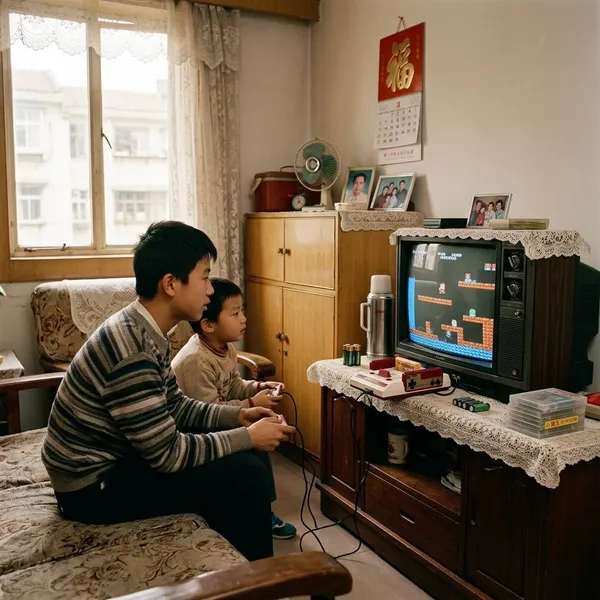
For a family buying a first game machine, that combination mattered more than originality. The setup was simple: connect it to the TV, plug in controllers, and start playing. No collector knowledge was needed.
Learning machine branding appealed to families
Little Tyrant's "learning machine" image helped it enter homes where a pure game console might have been rejected. Parents who worried about games as a distraction could justify the purchase more easily if the device also promised typing, study, or computer-like use.
Affordable games made home gaming more accessible
The hardware was only part of the appeal. Low-cost cartridges and multicarts made the system feel generous: one machine could quickly turn into dozens of playable games.
- For occasional players: a cheap multicart was enough to feel like a full library.
- For children sharing with classmates: borrowing and trading games kept interest alive.
- For cost-conscious parents: the total price felt easier to accept than official imported software.
A generation grew up playing Little Tyrant
Little Tyrant's lasting power comes from memory as much as hardware. For many people, it was tied to after-school play, crowded living rooms, sibling turns, and games passed between friends.
That is why the name still comes up when people talk about China's first console. It may not be the first by date, but it was often the first that mattered in daily life.
Why iQue Player matters in Chinese console history
The iQue Player matters because it marks a formal, official Nintendo step into mainland China. It sits much later in the timeline than CY-A, YQ-1, or Little Tyrant, but it answers a question those systems cannot: when did Nintendo release official home gaming hardware specifically for the mainland market?
Its commercial impact was not as broad as Little Tyrant's, yet its historical role is still distinct. It shows how a global console company tried to adapt hardware, software distribution, and localization for China rather than simply selling the same box used elsewhere.
Official Nintendo-backed hardware for mainland China
The iQue Player was backed by Nintendo and aimed at mainland China, which separates it from clones, imports, and grey-market access to Nintendo games. For readers comparing legitimacy rather than popularity, that official status is the key point.
Nintendo 64-based technology in a compact design
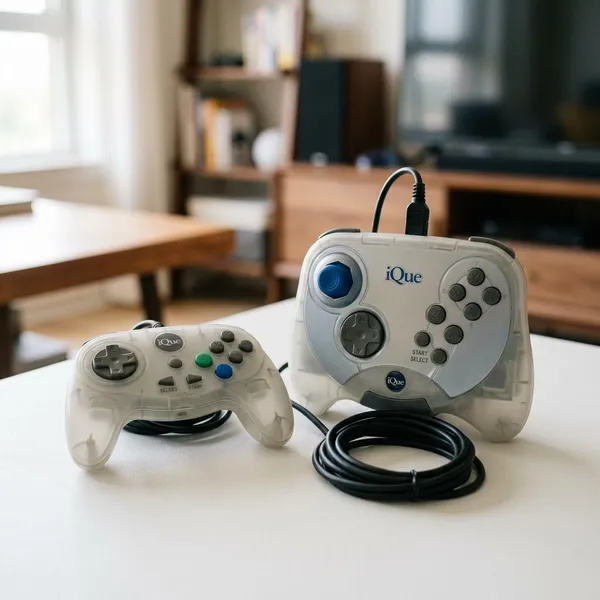
The iQue Player used Nintendo 64-based technology, but it did not look like a standard Nintendo 64. The main hardware was built into a controller-shaped unit that connected to a television, giving it a compact form that still feels unusual next to traditional console boxes.
If you are comparing systems by gameplay generation, "Nintendo 64-based" is a fair shorthand. If you are comparing the physical product, the iQue Player was its own China-focused design rather than a normal N64 with a different label.
Officially distributed Chinese-language Nintendo games
One of the iQue Player's clearest milestones was official Chinese-language Nintendo software. Players were not just using copied or imported games; the platform offered localized releases intended for mainland users.
The library was limited, so it did not become the defining home console for most families. Still, for preservationists and Nintendo fans, official localized software is exactly what makes the iQue Player worth separating from earlier unofficial access to Nintendo games.
A different milestone from China's earliest consoles
The iQue Player should not be placed in the same "first" category as CY-A or YQ-1. It came decades later and represents official international participation, not the beginning of domestic console hardware.
- Earliest hardware question: look to CY-A and YQ-1.
- Household memory question: Little Tyrant is usually the stronger answer.
- Official Nintendo question: iQue Player is the relevant milestone.
Conclusion
The cleanest way to answer is to name the category before naming the machine: CY-A and YQ-1 for the earliest known domestic hardware, Little Tyrant for mass-market home gaming, and iQue Player for official Nintendo hardware in mainland China. Trying to force all of that into one "first" hides the more interesting point: Chinese console history began with small early TV game experiments, became culturally visible through affordable family gaming, and later gained a separate official Nintendo milestone.