If you are asking is smartphone radiation harmful, the most practical answer is: normal smartphone use has not been shown to cause clear harm, but exposure can be reduced easily if you prefer a cautious approach. The key difference is that phones use low-energy radiofrequency signals, not the kind of radiation that directly damages DNA. If you make long calls, carry your phone against your body, or often use it in weak-signal areas, a few small habit changes matter more than worrying about every short text or scroll.

What kind of radiation do smartphones emit?
Smartphones communicate using radiofrequency energy, often shortened to RF energy. The word "radiation" can sound alarming, but it simply means energy moving through space. The important question is whether that energy is strong enough to break chemical bonds in the body.
For smartphones, the answer is no. Phone signals sit in the non-ionizing part of the electromagnetic spectrum, far away from X-rays and gamma rays. That does not mean exposure is magically irrelevant, but it does put everyday phone use in the right category.
Smartphones emit radiofrequency energy
A smartphone sends and receives RF signals when it connects to cell towers, Wi-Fi routers, Bluetooth devices, and GPS-related services. Exposure is usually highest when the phone is transmitting close to your body, such as during a call held against your ear.
The phone does not transmit at one fixed level all day. It may use more power when the signal is poor, when it is sending lots of data, or when it is moving between towers. A quick message at home on strong Wi-Fi is a very different exposure situation from a long call in a basement, elevator, or rural area with one signal bar.
Radiofrequency energy is non-ionizing radiation
RF energy from smartphones is non-ionizing radiation. That means it does not carry enough energy to knock electrons out of atoms or directly break DNA bonds. Ionizing radiation, such as X-rays and gamma rays, is treated differently because it can damage biological material in a direct way.
The main well-established effect of RF energy at high enough levels is heating. Consumer phones are tested against exposure limits designed to keep heating within accepted safety margins, although researchers continue to monitor long-term use patterns and newer network technologies.
It cannot directly damage DNA like ionizing radiation
Smartphone RF energy is not known to damage DNA in the same direct way as ionizing radiation. That is one reason major health agencies generally do not describe normal phone use as a proven cancer risk.
- Most ordinary users: brief calls, texting, browsing, and using the phone away from the head are low-concern situations based on current evidence.
- More cautious users: people who spend hours on voice calls or keep the phone pressed to the body all day may prefer simple exposure-reducing habits.
- Medical-device users: people with pacemakers or similar implanted devices should follow device-specific medical guidance about separation distance.
Is 5G radiation more harmful?
Current evidence does not show that 5G is more harmful simply because it is newer or because some 5G bands use higher frequencies. Like older mobile networks, 5G uses non-ionizing radiofrequency energy.
5G also uses non-ionizing radiofrequency energy
5G still belongs to the same broad non-ionizing RF category as 3G, 4G, Wi-Fi, and Bluetooth. Some 5G signals use frequency ranges similar to earlier cellular networks, while others use higher-frequency bands for speed and capacity.
Even then, 5G does not become ionizing radiation. It does not turn into an X-ray-like exposure because the network name changed. For a normal user, a phone on 5G sitting on a table is usually less of a close-exposure issue than any phone pressed to the head for a long call.
Higher frequency does not automatically mean higher health risk
Higher frequency can sound worse, but frequency alone does not determine health risk. Exposure depends on power, distance, duration, and how much energy is absorbed by the body.
Some higher-frequency signals do not penetrate as deeply as lower-frequency signals, so "higher" is not the same as "more dangerous" in a simple way. A useful rule is to focus first on habits you control: avoid long calls with the phone against your ear, especially when the signal is weak.
What increases smartphone radiation exposure?
The main exposure drivers are closeness, call length, and signal strength. If you want to reduce exposure without overthinking the science, start there.
| Situation | Why it matters | Practical move |
|---|---|---|
| Phone against your ear | Highest local exposure near the head | Use speakerphone or headphones for longer calls |
| Long voice calls | More total transmitting time | Switch to speaker mode, especially when on hold |
| Weak signal areas | The phone may increase transmission power | Wait for better reception if the call is not urgent |
| Phone tight against the body | Continuous close contact | Use a bag, desk, or nearby surface when practical |
SAR ratings can be part of the conversation, but they are not a perfect daily-use predictor. A phone's actual exposure depends heavily on how and where you use it.
Holding the phone closer increases exposure
Distance is the first thing to check. RF exposure drops quickly as the phone moves away from the body, so a phone touching your ear or tucked tightly into a pocket creates more local exposure than one a short distance away.
Longer calls increase total exposure
A longer call means more time with the phone transmitting near you. If the phone is against your head, a two-minute call and a one-hour call are not the same exposure situation.
Weak signals can increase phone transmission power
When the signal is poor, a phone may work harder to maintain the connection. This is more likely in elevators, underground parking, thick-walled buildings, rural roads, or trains where the connection keeps changing.
- Low concern: sending a short text or checking a map briefly in a weak-signal area.
- Better to avoid: long voice calls with one signal bar and the phone pressed to your ear.
- Simple check: if the phone gets warm, drains battery fast, or keeps dropping signal, reduce call time or move to a stronger-signal spot.
Distance quickly reduces exposure
A few inches can make more difference than people expect. Putting the phone on a table during a call, using speakerphone, or carrying it in a bag instead of tight against the body all reduce close-range exposure.
How can you reduce phone radiation exposure?
If you are concerned, reduce the exposures that combine three things: close contact, long duration, and weak signal. You do not need to stop using your phone or worry about every quick interaction.
Use speakerphone for calls
Speakerphone is one of the easiest changes because it creates distance without buying anything. It is especially useful for long calls at home, work meetings where you mostly listen, or time spent on hold.
Privacy is the obvious limit. If speakerphone is not practical in public, headphones are usually the better choice than holding the phone against your ear for the whole call.
Use wired or wireless headphones
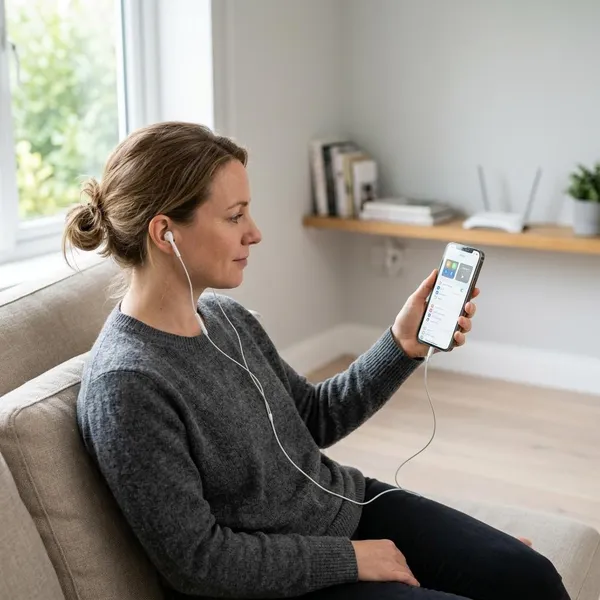
Wired headphones keep the phone away from your head without adding another wireless signal near your ear. They are a good choice if your main goal is minimizing RF exposure as much as practical.
Wireless earbuds and Bluetooth headsets still emit RF energy, but usually at much lower power than a phone communicating with a cell tower. For many people, Bluetooth is a reasonable compromise: less phone-to-head exposure, more convenience, and easier use during daily calls.
Keep the phone away from your body
When you are not using the phone, avoid keeping it pressed tightly against your body for hours if there is an easy alternative. Put it on a desk, in a bag, or on a nearby surface when practical.
At night, a bedside table is a better habit than under the pillow. That choice reduces close contact and also helps with non-radiation issues such as notifications, screen temptation, heat buildup under bedding, and interrupted sleep.
- Most useful first step: increase distance during long calls.
- Second step: avoid long calls in weak-signal places when you can wait.
- Optional step: keep the phone off your body during long idle periods.
- Common mistake: buying shielding products before fixing basic habits.
Conclusion
For most people, smartphone radiation is not something to panic about, but it is reasonable to be practical. The strongest current takeaway is that phones use non-ionizing RF energy and normal use has not been proven to cause cancer, while distance, shorter close-contact calls, and better signal conditions can reduce exposure with almost no downside. If you want a cautious routine, focus on long calls, weak reception, and carrying habits rather than treating every moment near a phone as a health risk.